What should come first?
Surgery, medication, more tests, a different hospital, or a multi-specialty review?
Share your medical records and test results with Future Doctor. We first organize your materials, questions, and related medical evidence: what matters most now, what is still missing, and which options are worth discussing with your doctors. When further judgment is needed, specialists or a multidisciplinary team (MDT) review and confirm.

01 / You may be facing this
The hard part is not finding more information. It is knowing which information applies to this patient — and what should be done first.
Surgery, medication, more tests, a different hospital, or a multi-specialty review?
You need to compare options against the condition, risks, hospital capacity, and the patient’s own priorities.
Which records to prepare, what to ask, when to follow up, and which warning signs mean seek care now — all need to be clear.
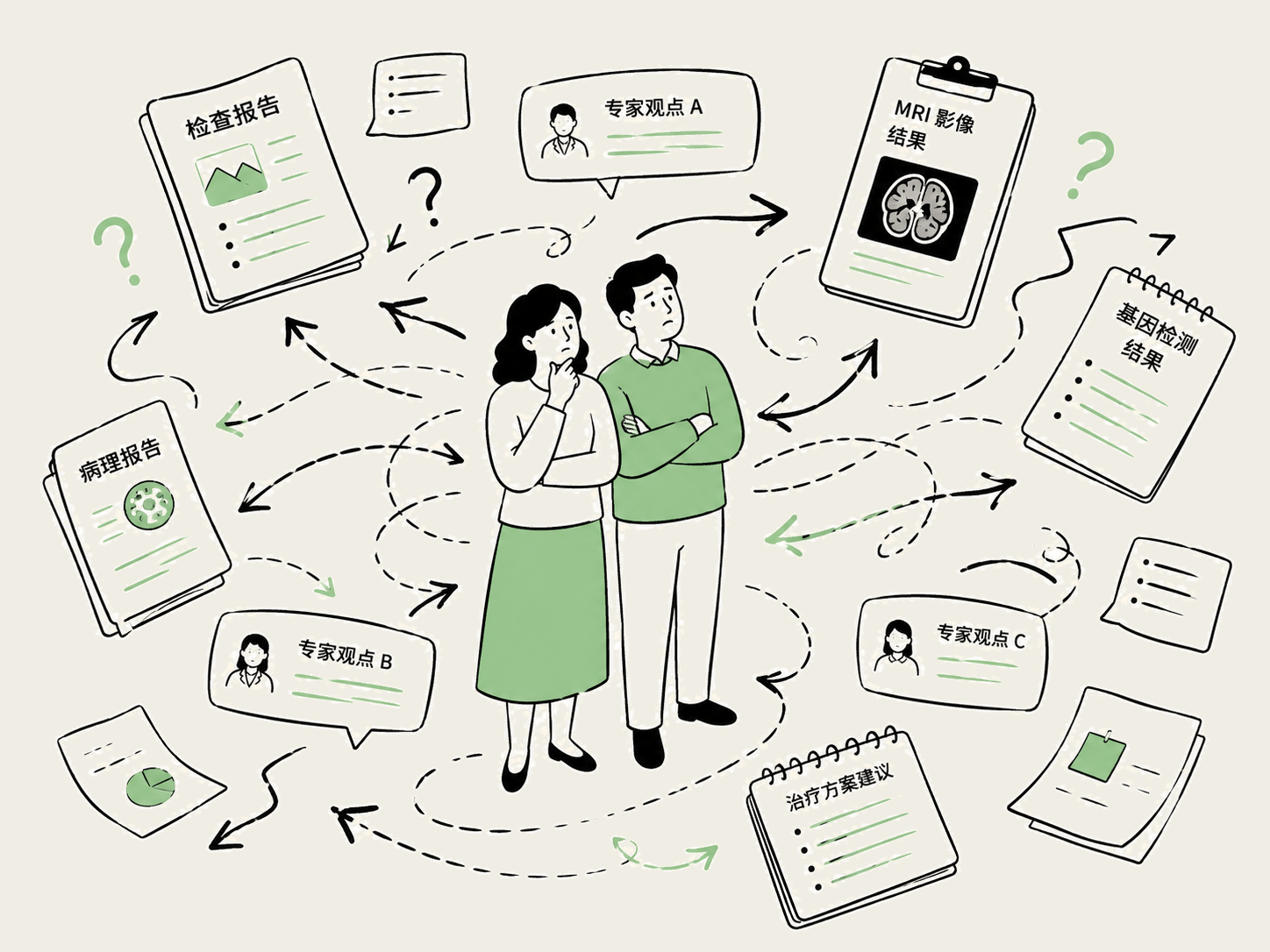
02 / First clarify the records and the questions
Future Doctor organizes your existing records, imaging, pathology, medications, and treatment history, and references guidelines, drug labels, and related research to form a preliminary analysis: what needs resolving now, which directions to consider, and what information is still missing. This helps you talk with your doctors; it does not replace a physician’s diagnosis or treatment advice.
Turn “What should I do?” into a concrete question — for example, get more tests first, or discuss treatment options first.
Explain when each option fits, what the risks are, and why some approaches are not advised right now.
Missing materials are never treated as known facts; we explain how the gaps affect judgment.
Note which tests or markers, once available, may change the order of further evaluation or treatment.
Case details anonymized · Ms. Chen · Stage IIIA lung adenocarcinoma · before physician review
Based on current materials, discuss first
This is a preliminary analysis based on current materials — not a diagnosis or treatment order. Key questions still require specialists or an MDT to confirm.
Initial organization is free. You can take it to an in-person visit. Whether something needs urgent action depends on the condition and your doctors’ advice.
Whether to ask physicians for further review or long-term follow-up is your decision after you understand the process and fees.

03 / When physicians are needed · second opinion & MDT
If doctors disagree, surgery is uncertain, treatment sequencing is unclear, or one specialty cannot answer alone, relevant specialists can review the full file. They state what is supported, what remains uncertain, and whether more materials are needed; when necessary, multiple specialties convene. The outcome is not a chat reply — it is a formal opinion reviewed and signed by the physicians themselves, with stated rationale and scope.
These questions still require physician judgment
Written reports cannot replace seeing the patient, reviewing original studies, or necessary offline tests.
Whether a given test or treatment can be completed at your hospital at this time.
Sequencing of tests and treatment must reflect the patient’s current condition.
Physicians use experience with similar cases to decide whether to adjust standard approaches.
Same patient · after physicians reviewed the preliminary analysis above
Formal team opinion
Case details above are anonymized. Names and opinions appear only after the physicians themselves have reviewed the case.
If one specialist re-reviews and issues an opinion, that is a second opinion. If multiple specialties must discuss together, that is an MDT. Which format fits depends on the clinical question.
Physician review is paid. Fees vary by number of physicians, seniority, and turnaround. Before starting, we confirm who participates, expected response time, and cost — and proceed only after you agree.

04 / Who reviews your materials
For second opinions, MDTs, or physician involvement in disease management, Future Doctor matches physicians at tertiary (Grade-A) hospitals to the problem at hand. Participating physicians are confirmed before service begins; you can see their hospital, department, and title.
This information appears in the opinion you receive.
After each physician comments, differences and next steps still need to be made explicit.
We do not promise treatment outcomes. What we can do is make clear who reviewed the file, which departments they represent, when the opinion was formed, and what remains uncertain.

05 / Follow-through during treatment and checkups · disease management
This service fits post-treatment recovery or long-term follow-up. A Future Doctor case manager continuously organizes test results, medications, and symptom changes; reminds you what to watch this week, who does it, and when to return; and escalates to physicians or offline care when something looks wrong. The goal is fewer gaps, missed checkups, and delayed risk response — not a promised outcome. Case managers record, remind, and coordinate; they do not diagnose or change treatment.

Case details anonymized · Ms. Lin · Stage IIIA lung adenocarcinoma, post-op
Different situations are handled differently
Recorded in this week’s case notes for the next review.
Adds symptom detail and timing; escalates to the attending physician when needed.
Document the abnormality; the physician decides what to do next.
No purchase discussion, no waiting for an online reply.
Confirmed materials, patient and family preferences, and ongoing tasks are retained. The case manager organizes new results so physicians re-review only what truly changed — and explains why an adjustment is needed.
Treatment sequence needs to change this time
Previous judgment
Surgery still under considerationCurrent judgment
Immediate surgery is no longer first-lineKept: prior materials, patient/family preferences, ongoing medications and observation tasks. Needs reconfirmation: treatment sequence and next follow-up timing.
This is disease management. It can start after physicians have advised on treatment, or earlier with a case manager organizing and following the current situation.
06 / What you will finally be clear about
Know the priority problem instead of being pulled by fragmented information.
From: organizing materials and questions
Know what the medical materials support — and what else could still change the judgment.
From: preliminary analysis
Personally reviewed and signed; hospital, department, title, and date are all visible.
From: second opinion or MDT
Patients and families know today’s tasks, who owns them, when to follow up, and which changes need immediate action.
From: disease management
New tests, symptoms, or opinions are organized by the case manager, with clear notes on what must change.
From: disease management
07 / Ongoing follow-through
Serious illness can mean a long course of care, while one physician service usually addresses the question at hand. During the agreed disease-management period, a case manager stays with you — organizing new materials, reminding you of checkups, and contacting physicians when re-evaluation is needed. Term and fees are explained before you start.
In either state, new tests, symptoms, and treatment results keep being recorded. When physicians must re-evaluate, prior materials are ready — no starting over.

08 / Trust boundaries · what we can and cannot do
Future Doctor never lets automated organization replace physician judgment. We can organize records, medical materials, and discussion questions, but a preliminary analysis does not replace in-person visits, physical exams, original imaging review, or prescriptions. Matters that need physician judgment are handed to physicians themselves.
We only state what can be known from materials actually received — and what remains uncertain. Missing information is never treated as fact, and treatment outcomes are never promised.
Unprovided materials are not treated as known; unuploaded imaging is not treated as reviewed by a physician.
Without personal review, the page never shows “reviewed”; without a personal signature, no opinion is shown.
It cannot replace physical exams, original imaging and pathology review, prescriptions, surgery, or other necessary offline care.
Conditions and results change. We state which changes require physician review again.
When immediate care is needed, go offline or call emergency services — do not buy a service or wait for an online reply.
If you have breathing difficulty, altered consciousness, persistent chest pain, or heavy bleeding, seek care offline immediately or call emergency services — do not wait for an online reply.
Start here
Describe the situation in your own words, or upload existing records and test results. Incomplete materials are fine — we will tell you what is still missing.
Initial organization is free. Whether to ask physicians for further review is your decision after you understand who participates, response time, and fees.

You can see each step as we read and organize what you submitted.
We only organize what you submitted. We do not invent facts, and we do not issue a diagnosis or treatment order.